
Sent December 1, 2025 to supporters of the Foundation for Economic Education
Friedrich Hayek noted that our minds were not designed for the vast modern world. They were shaped for life in small bands, where we understood every face, every tool, every rule. Gratitude, too, evolved for that scale. We thank the people around us. We thank the visible. We thank the familiar. What we rarely thank is the everything-sized human cooperation network that makes the visible and familiar even possible. The global system of strangers, institutions, technologies, and supply chains that sustains our lives without ever asking for our attention.
This creates a profound mismatch. Our moral intuitions demand identifiable benefactors. Our gratitude wants a face, a name, a story. But the baker who made your bread does not know you. The engineer who designed the chip in your phone never imagined you. The system that enables our existence has no face. You cannot thank an emergent order. You can only marvel at it, defend it, or fail to notice it exists.
More than enriching humanity, Ludwig von Mises wrote, capitalism allowed humanity to exist at modern scales. Before the Industrial Revolution, the world lived inside the Malthusian trap. Production grew too slowly to support large populations. Life was defined by scarcity, early death, and periodic collapse. The world supported barely one billion people, most of whom lived lives of grinding poverty that would be unrecognizable to anyone reading this today.
In the 1800s, global life expectancy was 29 years. In Britain, one in four children died before their fifth birthday. In Finland, famine due to cold weather killed more than 8% of the population. Every society was one bad harvest away from catastrophe.
Markets broke the trap. Innovation accelerated. Division of labor expanded. Global cooperation widened. Suddenly the planet could support billions rather than hundreds of millions. The small-world economies of the past became the everything-economy we inhabit today, held up by countless unknown contributors across continents. Today, global life expectancy is 73 years. Infant mortality has fallen from the historic norm of 48% to under 5%. The world supports 8 billion people, many, if not most, at living standards that medieval kings could not have imagined.
It is not just that capitalism feeds billions. It is that those billions now exist as moral agents with their own dreams, loves, and purposes. Every person alive today who would not have existed in a Malthusian world represents not just a statistical outcome but an entire universe of meaning, suffering, joy, and striving. Their children. Their art. Their contributions to the world. Their capacity to love and be loved.
Consider that roughly 7 of every 8 people alive today would not exist in a pre-industrial Malthusian equilibrium. That means nearly 7 billion individual human consciousnesses, each with their own inner life, exist only because certain institutional arrangements emerged in certain places at certain times. Not as an abstraction, but as actual people. Your children, if you have them. Probably you.
The market system is not justified because it is flawless. Its defenders do not claim it is beautiful, gentle, or kind. It is justified because it uniquely sustains mass human flourishing where every alternative has tried and failed catastrophically. Central planning could not feed, clothe, shelter, and empower billions. Neither can autarky or gift economies. When critics call for abandoning markets or “degrowth,” they are not suggesting a gentler version of the modern world. They are (knowingly or not) imagining a world that could not keep most of humanity alive. The historical evidence on this is not ambiguous.
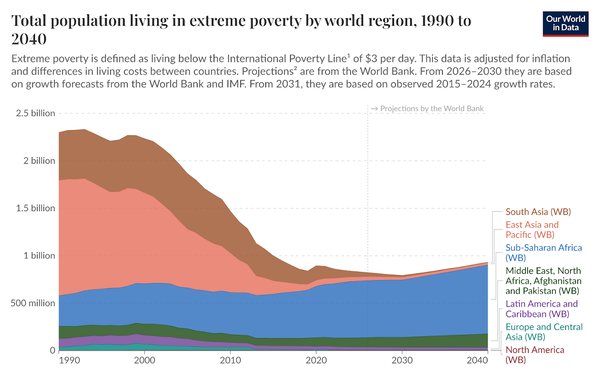
I want to drive that point home not only because of gratitude for the everything-world we live in, but to bring attention to a slowdown in extending that world to its poorest corners. Because poverty eradication, which seemed a fantastic promise made possible by global economic growth, is now coming to a halt. That’s what Max Roser from Our World in Data recently documented.
For three decades, global extreme poverty fell at a speed no previous century had imagined possible: from 2.3 billion people in 1990 to 830 million today—a reduction of 64% while global population grew by 2.8 billion. It was the greatest humanitarian achievement in history.
The problem is that this economic trend is stalling, and in some places it is on the verge of reversing. The remaining extremely poor people are concentrated in countries that are not growing. Most are in sub-Saharan Africa, with a few failed states elsewhere. These are also the regions where fertility remains very high. Their populations will rise rapidly as the rest of the world ages and shrinks. Combine stagnant economies with soaring populations, and global extreme poverty will begin to increase again.
 What Africa needs is what every other region that escaped poverty required: positive-sum games, secure property rights, enforceable contracts, low barriers to entry, freedom to trade, and the political and monetary stability that allows people to plan beyond tomorrow. The tragedy is that we know what works, but it remains so difficult to implement.
I came to America from the developing world, and I have seen both sides of this divide. I have watched brilliant entrepreneurs navigate impossibly complex regulatory mazes, bribe-heavy bureaucracies, and infrastructure that barely functions. And still build thriving businesses. The problem is never talent or drive. The problem is the games they are forced to play.
In America, I found what so many societies struggle to build: cultural and institutional arrangements that reward initiative, protect dissent, and let ordinary people dream bigger than their circumstances. The regions where poverty reduction has stalled are reminders of how difficult it is to build and maintain the positive-sum arrangements that allow mass flourishing.
Thanksgiving is a celebration of survival. For most of human history, survival itself was exceptional. Today it is the baseline expectation. That is the miracle. A miracle created by a system of cooperation that reaches across nations and cultures, powered by free exchange and human ingenuity.
But it is also a fragile miracle. An everything-system is easy to enjoy and easy to forget, which is why it cannot survive on passive appreciation. It demands what Hayek called the “cultivation of our second-hand traditions”: the deliberate transmission of the rules and institutions that make large-scale cooperation possible. Or, as Mises warned us, the survival of a free, prosperous society depends on two hard things at once: sound economic thinking by a few, and the slow, patient work of persuading the many to accept it. The “old liberals,” as Mises called them, believed the facts would speak for themselves. They don’t. Progress needs interpreters.
The positive-sum economic systems that sustain billions are not self-evident. They depend on people understanding why they matter, how they work, and what is at stake when they fail.
Thank you for everything.