

Yesterday, I introduced legislation to protect our Second Amendment rights by banning federal, state, and local laws targeting magazine capacity. The Freedom from Improper Regulation and Enforcement (FIRE) Act prohibits any federal agency from restricting firearm magazines based on capacity and prohibits states and localities from enacting or enforcing capacity restrictions on any firearm magazines.
In recent years, states and localities have enacted bans on “high capacity” magazines. While these restrictions differ by jurisdiction and firearm type (e.g. different limits for long guns and handguns), they prevent law-abiding gun owners from legally accessing the majority of available firearm magazines. A 2024 report published by the National Shooting Sports Foundation (NSSF), found that of the over 973 million detachable magazines that were produced between 1990-2021, at least 718 million had a capacity that exceeded ten rounds. This includes the period between 1994-2004 under the Federal Assault Weapons Ban.
The FIRE Act ensures the protection of Second Amendment rights by preventing state and local bans on magazine capacity. This commonsense legislation reflects modern usage as the NSSF data and brings our laws up to date with what law-abiding gun owners have long known.
For too long, the federal government has infringed on our Second Amendment rights while maintaining a confusing, inconsistent system that lacks a uniform national standard and invites legal disparity. The FIRE Act ensures that law-abiding gun owners can access magazines of any size, no matter where they are in the United States. It’s well past time we take the Founding Father’s words’ “shall not be infringed” seriously.
Thank you for starting your weekend off with us. I hope you enjoy this week’s edition of The Wied Wire. We are in search of fall interns for our Washington, DC, and District Office! If you or anyone you know is interested, you can apply HERE.
In the Wieds
Reclaiming Funds for America’s Priorities
Early this morning, the House passed the Rescissions Act, locking in key recommendations from the Department of Government Efficiency (DOGE) and reclaiming $9 billion in unnecessary federal spending. This bill rescinds $7.9 billion in foreign aid programs – including $3 million for Iraqi Sesame Street, $135 million to the World Health Organization (WHO), $1 million for voter ID in Haiti, and more. It also clawed back $1.1 billion from the Corporation for Public Broadcasting (CPB), which funds PBS and NPR. Most of public broadcasting’s revenue comes from private fundraising and state governments; however, federal taxpayers are still forced to foot the bill for these media outlets. By identifying frivolous and duplicative expenditures, DOGE’s efforts prioritize smarter use of taxpayer dollars and refocus federal resources on domestic priorities that directly impact American families, businesses, and communities.
Investing in Strength and Cutting Waste
Today, we also passed the Defense Appropriations bill for Fiscal Year (FY) 2026 – providing $831.5 billion to keep our military sharp, support the troops, and tighten up Pentagon operations. It keeps funding steady from last year, which means we’re holding the line while staying on budget and giving all service members a 3.8% pay raise. We cut out wasteful spending at the Department of Defense (DOD) by putting an end to the DOD’s taxpayer-funded DEI programs and drag shows, and increased funding for border security and counter-drug operations. Our FY26 Defense Appropriations Act ensures our troops have the resources they need, our borders are secure, and taxpayer dollars are focused on strategic investments, not bureaucratic waste.
Great Lakes, Greater Icebreaking
This week, the text of my bipartisan Great Lakes Icebreaker Act of 2025 was included in the Coast Guard Authorization Act of 2025, which passed through the House Committee on Transportation and Infrastructure by a vote of 60-0. Although the Great Lakes facilitate $3.1 trillion in gross domestic product and support over 25 million jobs, they are consistently overlooked when it comes to the need for icebreaking capabilities. The bipartisan legislation instructs the U.S. Coast Guard to develop a plan to design and build a new icebreaker for the Great Lakes and analyze the effectiveness of the current icebreaking fleet. I was proud to stand with Congresswoman McDonald Rivet (D-MI) and Congressman Miller (R-OH) to support this critical legislation.
Ushering in a New Era
This week, as a part of “crypto week”, the House of Representatives passed H.R. 3633, the Digital Asset Market Clarity Act of 2025. This landmark legislation finally sets a clear definition for digital assets, digital commodities, and blockchains to prevent confusion and bolster innovation in these ever-growing and evolving industries. It also finally determined which executive agencies regulate crypto and when. This bill positions the United States as a global leader in digital currency. The House Agriculture Committee, of which I am a member, and the House Financial Services Committee worked incredibly hard in a bipartisan way to deliver this much needed clarification and proved that strong legislating can still be accomplished. I am proud of the work my colleagues and I did to get this through the House of Representatives.
District Update
Meeting with NAIFA
I recently had the pleasure of meeting with members of the National Association of Insurance and Financial Advisors (NAIFA) at my District Office [see featured photo above] to discuss the importance of financial savings and the positive impact that tax policies in the One Big Beautiful Bill will have on their clients. Thank you to each of the NAIFA members who took the time to meet with me and for the great conversation!
Celebrating Local Businesses
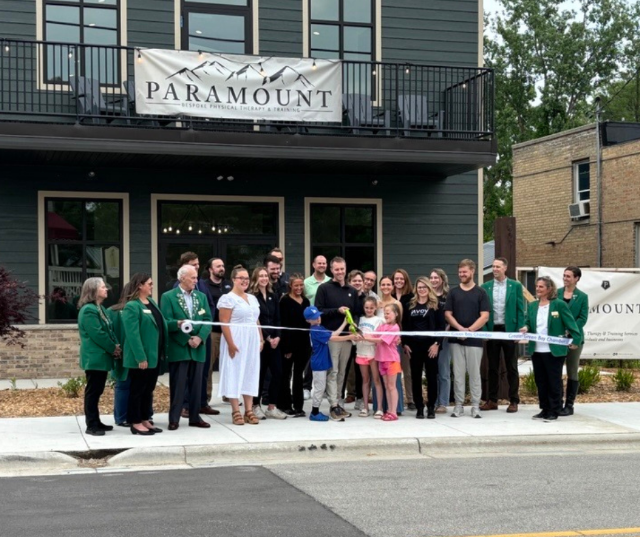
A member of my staff recently attended the Greater Green Bay Chamber ribbon cutting event at Paramount Physical Therapy and Training to celebrate their new location in downtown Suamico. It’s great to see local businesses expanding throughout Northeast Wisconsin and I wish Bryan and his entire team the best of luck at their new location!
REMINDER: 2025 Service Academy Nominations
In May, I announced that the 2025 Service Academy Nomination Applications were available on my website. As a reminder, applications must be completely fully and must be received by my District Office no later than 5:00pm on Friday, October 3, 2025. No late applications will be accepted, so pleas
Members of Congress may nominate candidates for appointment to four of the five U.S. Service Academies: U.S. Military Academy (USMA), West Point, NY; the U.S. Naval Academy (USNA), Annapolis, MD; the U.S. Air Force Academy (USAFA), Colorado Springs, CO; and the U.S. Merchant Marine Academy (USMMA), Kings Point, NY. The fifth service academy, the U.S. Coast Guard Academy (USCGA), New London, CT, does not require a congressional nomination for appointment.
Photo of the Week
We have received so many wonderful pictures since we launched the Photo of the Week section of the Wied Wire, and I would love to see more. This week’s photo is of a Blanding’s turtle on the move in Shawano. If you would like to submit a picture to be featured in our Photo of the Week section, please email it to twstaff@mail.house.gov with your name and location.