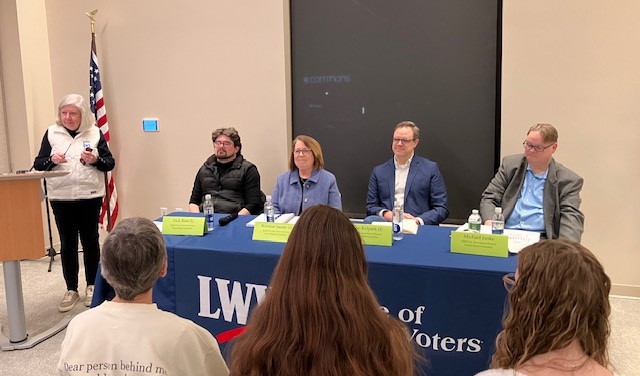
A March 5 school board candidates’ forum hosted by the League of Women Voters of Appleton-Fox Cities highlighted many differences between the three incumbents and one challenger candidate.
Challenger Michael Janke, who currently serves on the Outagamie County Board of Supervisors, was joined at the forum by incumbents Nick Ross, Kristine Sauter, and Jason Kolpack.
Three seats on the AASD school board are open. Voters are not, however, required to cast three votes: Your ballot will not be rejected if you vote for only one candidate in the race.
April 7 Referendum
The initial two questions focused on the April ballot referendum, through which the Appleton Area School District (AASD) is seeking $15 million for each of the next four years, a total of $60 million, for operational expenses. (This is in addition to the $129.8 million referendum for capital and operating expenses approved by voters in November 2022.)
Candidates were asked first if they support the referendum, and second what they would cut or protect if the referendum isn’t approved.
Not surprisingly, all three incumbents support the referendum, while challenger Janke does not. As for what they would cut or protect if the referendum isn’t approved, Kolpack seemed to speak for all three incumbents when he admitted, “I really don’t want to think about that.”
Janke said he would “protect all student-facing programs,” but that everything non-student-facing “should be on the table.” He noted, in particular, that the school district needs “a frank conversation about infrastructure in light of our declining enrollment.”
Kolpack said the school board is “evaluating what we can do to reduce spending” … but then he followed that by admitting “we may need to go to referendum again.” Sauter and Ross blamed the state legislature, with Ross saying the district’s finances aren’t likely to improve “unless the state funding formula is changed.”
Janke also said the referendum has to be viewed in light of falling student achievement. “We are investing in a system that is failing our students,” he said. “If you exclude Appleton North,” he said, “61% of the district’s students can’t read or write.” He recommended returning to a “third-grade cutoff” policy, whereby students who aren’t performing at grade level in third grade are held back.
Ross and Sauter forecast that student achievement will improve, over time, with the state legislature’s passage of the Act 20 literacy changes. “Those changes have been so hard on staff,” Ross said, and Sauter agreed, noting “our educators have had to work so hard to change, but we’re on the right path.” Both suggested getting the “literacy piece” right would lead to improvements in achievement in math and other subjects.
Non-Traditional Learners
An Appleton high school student asked the candidates what they would do for “non-traditional learners who aren’t special ed and stay in mainstream classrooms, or those who go out of the mainstream setting.”
The incumbents said more resources were needed to help those students, with Ross responding simply, “pass the referendum.” Sauter said the schools need “additional counselors” so those students have a resource to talk to about what works for them.
By contrast, Janke focused on the students: “We have to challenge the students, ask if they really need special treatment. We’re a public school district,” he said, “not a boutique.”
Other Questions
Candidates were also asked to address questions about:
- Censorship on student Chromebooks and service interruptions. Ross said the district was “doing the best it can with the resources they have,” while Kolpack noted there is “a fine line to be drawn” on sites students simply shouldn’t be permitted to access. “Security is the opposite of convenience,” he noted.
- Truancy citations. Janke said “excused absences are one thing, but not showing up is different and must have consequences.” Ross doesn’t support the truancy citations program, while Kolpack noted the district has “dedicated attendance coordinators” at the high school and middle school levels.
- Curriculum development. Ross noted the community is given a 30-day window to review new curricula, but “Nobody does.”
- Phone/Tech in schools. All seemed to support the “bell-to-bell” ban on student cellphones, with Sauter noting she has heard from teachers who are especially pleased with the ban. And Kolpack noted “maybe we can claw back some money by not relying so much on Chromebooks and online texts.”
Closing Remarks
In their closing remarks, the three incumbents emphasized that the “current school board is strong, we just need more time” [and apparently money]. Challenger Janke returned to his principal theme: “Our spending is going up, performance is falling, and we need a frank and honest discussion” about how to turn things around.
The 1.5-hour candidate forum, held at the Appleton Public Library, was recorded. The full video will be posted on the League of Women Voters of Appleton-Fox Cities website and at VOTE411.
Absentee voting opens March 24. Visit MyVote Wisconsin to make sure you’re registered, find out what’s on your ballot, and identify your polling place.